Review of Raw Blue, by Kirsty Eagar

rashie

We learn as we grow that for many of us our real spirituality has nothing to do with what most people would identify as ‘religion’. That is certainly true of Carly, the narrator of Kirsty Eagar’s Raw Blue. I don’t know anything about surfing (& I knew even less before I read this story), but her type of ‘a nineteen-year-old-disappointment’ is one that I often encountered my younger days; they were yacht crew or skiers, backpackers, climbers—nomads who worked, when they absolutely had to, as bartenders, cooks, housekeepers, wait-staff—& with luck @ something related to their passion, like sailmaker‘s apprentice, rigger, ski patrolman, guide or ranger. Their avocation wasn’t just the most important thing in their lives; it was the only thing. They drifted in & out of relationships because there was always another boat, another mountain, another trail, another wilderness area, another beach calling. Lots were college dropouts but some had advanced degrees & there were times when I was sorely tempted to join them.

Carly lives in Manly, a suburb of Sydney with great beaches. She surfs every day & works from 4.30 to midnight as a chef @ a moderately upscale restaurant. She drives a clapped-out Laser (the Australian Ford version of a Focus), & lives with a Dutch housemate named Hannah. Conspicuously no boyfriends but some really bad dreams & we are aware but a few chapters in that Carly’s backstory includes a serious trauma. That is common with those who embark on this kind of spiritual pilgrimage. They are often suffering from the effects of grief, wars, abusive relationships, victims of rape, or betrayal. Cheryl Strayer’s Wild seems based on that premise. Their athletic/spiritual discipline assuages the pain, if it doesn’t cure it, something really understood in the Middle Ages: by the time you reached Walsingham, even better Compostella, you’d probably have your stuff pretty much sorted.

It took me about half way through Raw Blue to be sure it was going to work for me, but I was buoyed by reviewers comparing Kirsty Eagar favourably to Melina Marchetta (taking population into account, I think Australia has more superb authors than anywhere else in the English-speaking world), which is a very high standard indeed. I’d rank On the Jellicoe Road over Raw Blue, but mainly because Taylor Markham has more opportunities in a more complex setting & series of roles than Carly, but spiritually Raw Blue turned out excellently. I think this passage is one that brings out well what surfing means to Carly: ‘But when it comes down to it, getting up is easy. I’ve left it late but sometimes the more critical part of a wave is better; you use the wave’s own energy, a quick suck-push that picks you up & throws you on the board. There’s a frozen moment a snapshot in time, where I realise I’m standing, abut to take the drop, and the drop’s steep but that’s good because I can already feel the surge & swoop of it in my belly. I make my bottom turn and see the wall stretching away in front of me, the muscle of the wave, steepening up sharply with the promise of speed.’ What could come nearer the mysterium-tremendum than standing on a board playing on the face of a huge wall of water?

To find out what some of the surfing terms, such as ‘bottom turn’ mean, I did the same thing I did with the cheer stunts in Dare Me, went to YouTube & watched. If you feel put off by the technical surfing descriptions, that will let you see what Carly is describing, even if we can’t actually feel the sensations. For local Australian expressions, there’s Google. I already knew a ‘panel beaters’ was ‘body shop’ for us Yanks, but I loved the joke about the ‘Centre-Link surfing team’ when I discovered that Centre-Link was the welfare office.

This is a book about spirituality & athleticism @ a high level, about healing & recovery, growth & maturity, friendship, & a moving love story featuring one of the most patient & caring men I’ve seen in recent fiction who finds in Carly a young woman who’s worth the effort. As she is ours.

Review of The Beauty of the End, by Debbie Howells

There are plots that seem to work better in some literary genres than in others, & revisiting a past relationship that didn’t work out seems to be one of them. Great in romantic fictions such as Jane Austen’s Persuasion or Jojo Moyes’s The Last Letter from Your Lover. But in crime fiction, I’ve been disappointed: Peter Swanson’s The Girl with a Clock for a Heart, Mark Edwards’ Because She Loves Me, & David Bell’s Somebody I Used to Know, all tanked. Perhaps it’s that the bereft lover has to play such an unappealing role, passively waiting for the beloved’s return steadfastly but without hope. (Granted, Captain Wentworth was anything but passive facing a French – or American – frigate captain, but as a wooer of Anne he hangs back till the very end.)

In The Beauty of the End Debbie Howells could give the narrator Noah Callaway a personal soundtrack: ‘Have You Heard about the Lonesome Loser?’ His parents (& the author) graced him with an awfully wet name for a hero (even he jokes bitterly about it) & it fits him – one of those unfortunates who go through life with his own little raincloud over his head. (His surname is also redolent of ‘callow’.) He allows himself to be repeatedly jerked around by April, the the object of his obsession, by Will, his BestFrenemy, & by Detective Sergeant Ryder (@ one point the author forgets his rank & promotes him to Detective Inspector tho’ he subsequently reverts). Noah even allows himself to be bullied by his landlady @ the BnB, even tho’ he is supposed to be both a lawyer & a moderately successful crime-fiction writer. (We are told that he abandoned practice @ the criminal defence bar stricken by remorse when a client he successfully defended proceeded to reoffend. Surely even the most junior defence barrister – not to mention detective story writer – knows that 9/10 of the defendants actually did it – the reason for defence is to make the Crown prove it.) You would think a trained barrister, not to mention crime fiction writer, would know how to stand up to an overbearing cop, not to mention a landlady.

Not only did April’s giving Noah the el dumpo nearly @ the altar break his heart; it also ruined the storybook wedding he was planning: he was ‘imagining a country house wedding with April in a beautiful dress & all our friends crowded around us. “We should check out some venues,” [he] told her. “Places get booked up.”’ Had I not requested this book from NetGalley, it would have hit the DNF pile here. The groom makes the wedding plans? Most us guys’ notion of wedding planning is going online @ Expedia to book two tickets to Vegas!

As the story unfolds the improbabilities multiply. April has apparently ODed & is in the ICU & Noah believes that one of the doctors is sneaking in & altering her medications to kill her – this doctor supposedly being a distinguished paediatric surgeon & having the nurses so in awe of him that they don’t question anything he does, even tho’ he is not April’s attending physician or qualified to be assigned to an ICU. There is no chance @ all of anything like that happening in any real ICU, where the nursing staff closely supervise & administer all medications – that’s why it’s an ICU. Not only do the nurses constantly monitor the pt’s medications & condition, but they review them daily as a team. There’s no possibility that a consultant in another speciality – such as paediatric surgery – could simply walk in & start administering something else that the pt’s proper doctor hadn’t ordered.

We are also supposed to believe that April practised as a grief therapist for bereaved mothers of newborns, tho’ we are not told how she acquired her qualifications, but after so many other unlikelihoods, why complain? Finally Noah uncovers the very much expected villain and the villain’s very much improbable plot. Oh, & there’s also another occasional narrator who talks in italics & we finally find out what she’s doing in the story. At the end, Noah finds a new role: it’s not as a wedding planner.

In future I’ll not request advanced review copies of NetGalley except when I’ve already read & liked books by that author. But tho’ I am grateful to NetGalley & to Kensington Books for this ARC, I thought the only thing beautiful about the end of this book was actually reaching the end.

Review of The Butterfly Girls, by Dot Hutchinson

the-garden-of-earthly-delights-1515-7

The garden is an archetype deeply imbedded in our literary unconscious. In mediaeval poetry such as The Romance of the Rose, the enclosed garden, or hortus conclusus as it is termed in Latin, is both the site & the symbol of making love, with the object of the lover’s desire represented as a beautiful & fragrant flower. The beloved can also be imagined figuratively as a rare jewel or like Eros himself, as a winged creature, a beautiful bird, or perhaps a butterfly. But in the literature of supernatural horror, the garden of love has a diabolic counterpart, a garden of evil, fecund with poisonous plants, deadly nightshade, belladonna, overrun with weeds hiding hideous scaly creatures & toads. In the imagination of a master such as Bosch or Poe, the love garden subtly transmutes itself into the garden of death. Dot Hutchison bases The Butterfly Garden on this contrast. If I could chose a soundtrack for it, that would be “Beautiful Poisons” by Paige Anderson & the Fearless Kin. A very wealthy collector abducts teenage girls & transports them to his isolated estate. He inks them with exquisitely colored tattoos of different butterfly species that they will display their wings for his aesthetic pleasure in backless dresses, & after that he rapes them. He also gives them new artsy sounding names such as Maya & Ravenna. He keeps more than 20 of them, allowing them to flit about in a garden closed off from the rest of his estate till they reach the age of 21. Then he finds another way for them to gratify his artistic tastes. The girls refer to him as “The Gardener” but of course we’ve met him in horror stories often before–as the commandant of the concentration camp, the governor of the penal colony, the master of the slave plantation, the ogre in his castle, the demon king.

This tale is told by Maya (a.k.a. Inara), one of the girls, with her audience two FBI agents, & we learn @ the very beginning that many of the other abducted girls have been rescued as well. That is why I began this review by talking literary history & theory, not just to show off that I spent too much time in an English department. (Tho’ I’d love to have had Maya as a student; she is very well-read & could teach me a lot.) For I find the 1-star & dnf reviewers seemed to have in common trying to read The Butterfly Garden in the wrong way, as a failed attempt @ writing a realistic suspense thriller, & hating it. If instead you read it as a conte philosophique, a theological romance (like M. R. Carey’s Fellside, which I just finished, or C. S. Lewis’s That Hideous Strength), & a full-bore-no-speed-limit tragedy, this book will blow your doors off.

The philosophy is that of the 17th-century mathematician & Christian Blaise Pascal: Qu’on s’imagine un nombre d’hommes dans les chaînes, et tous condamnés à la mort ; dont les uns étant chaque jour égorgés à la vue des autres, ceux qui restent voyent leur propre condition dans celle de leurs semblables ; et se regardant les uns les autres avec douleur et sans espérance, attendent leur tour. C’est l’image de la condition des hommes. Substitute “jeunes filles” for “hommes—tho’ the Gardener does something more artistic & kinkier in private than cutting their throats in full view, but each indeed looks on the other girls with sadness & without hope while awaiting her turn.

Maya hasn’t studied philosophy or French, but she does know Greek tragedy. This is her take on Sophocles’ Antigone: “I always thought she was pretty cool. She’s strong and brave and resourceful, not above a certain level of emotional manipulation, and she dies, but on her own terms. She’s sentenced to live out the rest of her days in a tomb and she says fuck that, I’m going to hang myself. And then there’s her betrothed, who loves her so much that he flips his shit at her death and tries to kill his own father. And then, of course, he dies too, because come on, it’s a Greek tragedy, and the Greeks and Shakespeare really love killing people off. It’s a great lesson, really. Everyone dies.” Her switch in “registers” (as a professor of linguistics would term them) from “fuck that” to “a certain level of emotional manipulation” to “flips his shit” fits a teenaged autodidact nicely, & we have to remember that she is quite deliberately playing the FBI agents like a couple of fat stupid trout @ the end of her line. There is indeed a character in the story who plays the role of Haemon to Maya’s Antigone, as well as acting a part in a diabolic parody of Jesus’ parable of the prodigal son.

But I had some Problems:

Maya is indeed “strong & brave & resourceful” which made me expect she’d play a much more active role in the girls’ escape. Maya has assumed the role of head-girl or big sister & she ought to be the one who effects the denouement. The ending seemed very flat. Having gazed repeatedly and deeply into the abyss, Maya & the other girls will have been marked & set apart forever. Some may, as is remarked, commit suicide. Some, & I hope Maya is one of them, may be even stronger, braver, & dedicated to doing good & combating evil. I’d like to see a sequel set a decade later.

Spiritually & morally, the author seems clueless. Like so many contemporary people with a modern education, she is very aware that there is something monstrously hideously wrong with what the Gardener is doing, but lacks the concepts & vocabulary to express that awareness, so the only thing Maya & the FBI men can say to describe this horror is that “it is against the law.” How the Gardener tramples upon & violates the moral & natural order (the girls’ unnatural tattooed butterfly wings & mounting the butterfly girls’ bodies in display cases are obvious signs of his unnatural appetites, like the metal trees in Lewis’s Hideous Strength), as well as denying the girls their most basic humanity in reducing them to objets d’art, is apparently inexplicable in contemporary culturally relativist terms known to these characters, & I suspect the author as well..

Anyway, let me know what you think. Borrowing a metaphor from Taylor Swift, I’d say The Butterfly Girls was a ride in a new Maserati up a dead end street. But this one’s a classic, not a new Maserati, rather one of those GP Maseratis from the ‘50s like Sterling Moss might have driven. And what a ride!

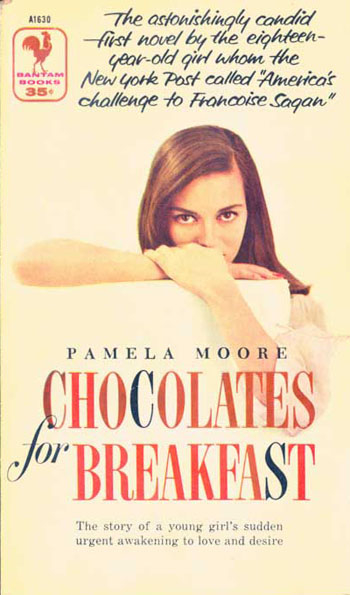
Review of Chocolates for Breakfast, by Pamela Moore

Chocolates

I was drawn to this book about a teenage girl because it was published when I was a teenage boy & indeed the idiom brought back the 50s wonderfully: “ it’s a blast” “have a ball” “making out” “weenie” “that’s a drag” “out of it” – as well as some of the little details, like the new white luggage Courtney’s mother buys for their return to New York. I can’t recall wanting to read Chocolates for Breakfast then but I know I didn’t. I read Bonjour Tristesse, tho’ I had no idea who was this Bergson that Cécile was supposed to be reading for her exams & wasn’t. Of course I read The Catcher in the Rye because it was the book members of our clique were supposed to like. Tho’ belonging to the same period, The Bell Jar appeared only in 1963, after Plath was dead. Like Plath, Pamela Moore was a suicide, but unlike Plath & of course Salinger, she’s never been idolized by a cult. Yet now I found the principal character of Chocolates for Breakfast Courtney Farrell much more attractive & intriguing than either Esther Greenwood or Holden Caulfield, & frankly the whole family of Glasses too! In my current idiom, the chick rocks! In my teens, I wouldn’t have liked Courtney, but I’d have been very attracted to her but she certainly would’ve preferred older men. Which would have made her even more attractively out of reach.

Courtney’s jejune spirituality struck a chord too. I can still recall the effects of the same highly toxic species of pre-Vat-II Roman Catholicism that offers Courtney no consolation or spiritual sustenance but buckets of guilt instead. Unfortunately her school could not provide her with a formation either, tho’ I thought Miss Rosen could have been the model & guide every teen needs, providing a significant relationship with an adult who is not a parent (like Coach & Addy in Dare Me).We sense that Miss Rosen got a word to the wise from the headmistress that her relationship with Courtney might be getting too close for propriety. But it was unfortunate she dumped Courtney, because there is no one else Courtney can rely on for advice & support in dealing with relationships. As for her lovers, I found Barry likable but very weak, as you’d expect of a failed actor turned professional boy-toy. Anthony struck me as a purely literary creation out of Wilde & Waugh, but believable as a contrast to the odious collegian drunks who are very true to life indeed. Courtney’s BF Jane is the stereotypical party girl of the time, popular because she is “easy” & her fate is all too believable. Several of my friends had alcoholic fathers not unlike hers.

So Chocolates for Breakfast strikes me as a fairly true picture of what life was like among the upper classes in America in the 1950s, with its clouds of tobacco smoke, rivers of alcohol, & total spiritual malaise. Not @ all like the time of confidence & prosperity that it is too often portrayed as these days. Even if I’d had the chance to encounter her – she was only four years older than me – Pamela Moore probably would have represented a very high maintenance friendship indeed. But now I think I’d have liked to have had the chance to try.

Just maybe I’m ready to give Bonjour tristesse another go – en français this time.

Review of Niceville, by Carsten Stroud

M82A1_barretthqdefault

Niceville received some favourable reviews from friends & I’m a bit embarrassed to have found parts of it so nasty, tho’ I immensely enjoyed others. If I’d read a book like this when a 20-something starting his career as a student of satire, I would have put Karstein Shroud (mangling characters’ names is the sort of humour he apparently finds hilarious so I’ll return the favour) in the Jonathan Swift class. But now I am trying to become a better person & prefer Jo Jo Moyes instead. My old self tho’ wallowed in the descriptions of mayhem, especially the account of a sniper with a .50 calibre Barrett blowing away a ‘chopper’ (much of this book is written in a pseudo-military macho dialect in which ‘chopper’ is also a verb meaning ‘to travel by helicopter’) containing a ‘newsgirl’ along with the pilot. (‘Basically the guy exploded, the hydrostatic shock wave blowing through the water-filled tissues of his body @ the speed of sound, like an asteroid slamming into the sea.’) Then the sniper whacks four police officers, each in a different ‘cruiser’!  Altho’ the author lives in Toronto, this book is set in an unnamed region of the American South, & so is woefully lacking in Canadian content. Had I been Karstein’s editor I should have suggested he make the police victims members of the OPP, the ‘newsgirl’ CBC, & the rogue-cop shooter RCMP, so the book could be a contribution to Canadian culture.

I did love the scenes on the Ruelle plantation, where we travel back to the 1920s (no, Glynis could not have given Merle a ‘Colt Commander’ – hadn’t been introduced till 1950 – I still know my Guns & Ammo stuff too.) I also liked the gunfight @ the palliative care centre (my current career lets me spend a lot of time in such places but it’s not so exciting altho’ in the ER I sometimes get to be in a TV cop show but with real cops – who seem much nicer people than the cops in this book). There are some moral & spiritual values in this book – bravery – tho’ how do you worry about being killed in a duel if in fact you are already dead? – combat skills & technical efficiency. One of the characters is supposed to have taken part in the D-day invasion (hardly likely as he is said to be 74 y/o now) in the ‘Big Red One’ (American 1st Infantry Division if you’re not speaking macho-pseudo-military jargon) – the Das Reich division would have been more appropriate for most of these characters.

Review of Fellside, by M. R. Carey

Wakefield_Training_Prison_and_Camp-_Everyday_Life_in_a_British_Prison,_Wakefield,_Yorkshire,_England,_1944_D19198

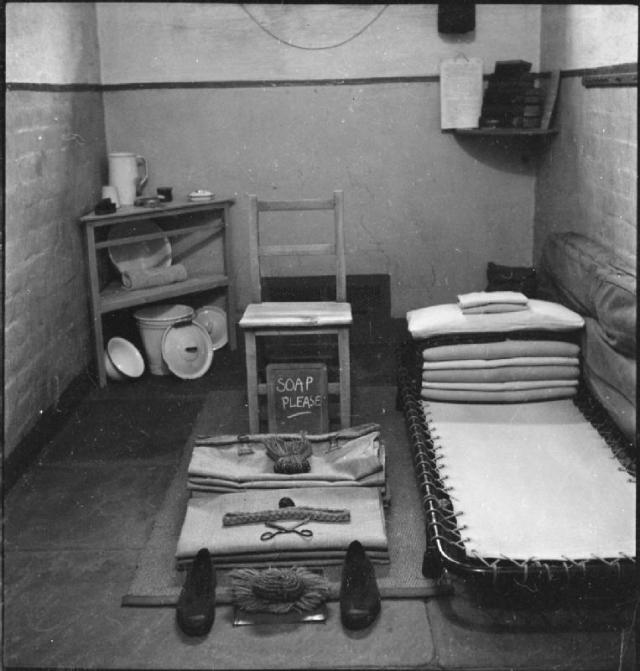
Heroin addict Jessica Moulson receives a life tariff for starting a fire that causes the death of a small boy. She had no intention of harming the boy Alex – didn’t know that he was even in the building. But the prosecution claimed that she did intend to kill her fellow addict boyfriend & she was convicted on his testimony, which legally makes her a child killer. At 1st sight that seems unfair, but when you think about it, it makes sense. Suppose I’m in the zebra crossing along with your ex, whom you try to run over with your motor car, only the ex jumps safely out of the way & you obliterate me instead. You’ve certainly murdered me even tho’ you never so intended.

If you’ve read books like Alex Marwood’s The Wicked Girls, you know what public fury & media frenzy those convicted of murdering innocent children arouse, & prison inmates are as judgemental as most of us, so we’re not surprised that Jess will become an object of opprobrium & a target for bullying. Which logically & morally is senseless in her case, but brings out the distinction between legal guilt & moral responsibility. She is only supposed to have tired to kill the druggie boyfriend, so whilst legally she is guilty for the death of the child, morally she is blameworthy only for encompassing death of boyfriend. Even before we learn a lot more about him in this book, we’d hardly see his demise worthy public outrage.

Thinking about that paradox was only the beginning of the moral & spiritual issues you’ll find yourself facing in Fellside. I think M. R. Carey’s The Girl with All the Gifts was a better executed story, but Fellside is on a higher artistic level. Both are quest stories. Girl with All the Gifts a journey quest whose progenitors are The Odyssey, the Anabasis, the Morte d’Arthur, Pilgrim’s Progress, Journal of the Plague Year & The Lord of the Rings. These recount journeys by a group of friends trying to find their way to a safe haven through many dangerous adventures. The present story is a katabasis, a descensus Averno, like the sixth book of the Aeneid, the gospel of Nicodemus, & Dane’s Inferno. H.M. Prison Fellside is supposed to be in the Yorkshire moors geographically; spiritually it is directly over the pit of Hell. Normally on such a quest the pilgrim voyager is accompanied by a spirit-guide: Aeneas by his father Anchises, Dante by Virgil. Jess’s spirit-guide is apparently the ghost of the dead boy Alex who perished in the fire she was convicted of starting. Jess initially attempts to starve herself till as she approaches death she meets this spirit in her dreams who leads her to choosing life, even life in prison. Slowly Jess develops her spiritual powers & her friendship with this spirit, who gradually reveals yet another identity.

You may read other reviewers who were disappointed by Fellside, because they loved The Girl with All the Gifts & wanted another adventure story, or maybe a mystery story, or a supernatural horror story. There are all of these elements in Fellside, but spiritually it’s much more elevated. As an example of one of those standard fictional genres, Carey could have ended this book 60 pages earlier than he did – & I would happily have given it four stars & it could have had an HEA epilogue as well. When I heard where Jessica stood up in the appeals court after the verdict to make a personal statement & I sensed the direction the book was taking, I wanted to stop the car & scream ‘Jess, Don’t do it!’ But of course she had to do it. This is a story of redemption. Now that we’ve been redeemed, what do we do about it? We don’t want anything bad to happen to anybody. But when it does, we want to be there. So we ask to be posted back to the front line, to the trauma unit, to the mission outpost, to the entrance to the dark cave concealing the downward path leading straight to . . . . As long as there’s unfinished business to take care of, we don’t leave anyone behind. In this book M. R. Carey chooses to have his hero Jess go for full-blown tragedy: unnecessary, excessive, cruel, but also inevitable & right – & very beautiful

Review of Roses and Rot, by Kat Howard

Tho’ I know Christina Rossetti as the author of the most moving Christmas carol I have ever heard sung, I’ve never read her poem Goblin Market. But after reading Roses & Rot, I know that I certainly must. But the “Night Market”–as it’s termed in the book—is just one attraction of an artists’ colony called Melete, located north of Boston—next to a bridge leading straight into fairy land. Every seven years the outstanding fellow is offered the opportunity to spend seven years “away with the fairies” (in that marvelous Celtic phrase) as a “tithe” to the Fae, with a virtual guarantee of artistic fame thereafter. If like me you’re fascinated by the thought of living in a world where the bounds between everyday reality & a realm of magick are tenuous & thin, you wiil hugeluy enjoy this book. Previously I’ve been entranced with seemingly “realistic” school stories with archetypal elements from fairyland such as Anton DiSclafani’s The Yonahlossee Riding Camp for Girls & that classic of the genre, Alain Fournier’s Le Grand Meaulnes. This time we have the real thing. Kat Howard subtly introduces the fairy elements with a matter of factness we believers expect. The first time that a befeathered & befanged party of riders suddenly appears, we think, Oh, that’s the Wild Hunt. Sure. And we know where we are now. The story requires lots of invention—an art colony run by the Fae seemed new to me—but we’re well within the tradition of fairy lore as found in Shakespeare’s Midsummer Night’s Dream & Celtic myth.

This is also a tale about relationships, featuring two sisters (like Goblin Market). Here Imogen, the elder sister, is a story writer, & Marin, her sister younger by two years, is a ballet dancer. They have a hideous mother who fits the role of wicked stepmother or witch, but she’s just their natural mother. Ostensibly everything she does is for the girls’ own good, providing Imogen especially in lessons in humility & self-control. But it was in this depiction of mother-daughter relationships that I found this story disappointingly improbable. We might think probability & realism scarcely matter in a world where your lover might sport a set of antlers when his “glamour” isn’t working to make him appear to be only a famous human dancer. Actually, it’s the opposite. The more fantastic-seeming the details, the more consistency & logic is required; as C. S. Lewis once noted, in myth an apple tree may bear golden apples, but never pears. As both sisters are grown & pursuing their careers, why would they continue to allow their mother to persecute them? Why don’t they block her verbally abusive & passive aggressive (“poisoned paper cuts”) emails & toss her “gift” packages in the trash unopened?

Perhaps fortunately, the abuse the sisters suffered in childhood is unlikely to be unnoticed in real life. Both sisters have permanent scars from their mother’s burning Imogen’s stories & Marin was taken to the hospital. Any ER nurse would have been highly suspicious when a child presents with such injuries—they are mandatory reporters, as are the girl’s teachers @ school as well—mother left Imogen’s burns untreated. It is also very unlikely that Imogen’s mother could have sabotaged Imogen’s award @ school for best story by accusing her daughter of plagiarizing it from her. Any teacher would know a good student’s work immediately. In real life, thank Heavens, a mother like this would long since have been spotted as a crank & a fantasist even if the girls weren’t taken into care. As if one cruel mother weren’t more than enough, @ Melete we meet Janet, mother of the unfortunate poet-fellow Helena, who is equally demanding, controlling & destructive. I’d hope in reality both mothers would long since found themselves in a psych hospital.

Of course terrible parents are a staple in fairy tales, but these are unremittingly & unnecessarily horrible & dragged the story down terribly, @ points making it almost unreadable. In contrast, the relationship between the sisters Imogen & Marin, tho’ conflicted, is beautiful & caring. I quite loved Marin’s affair with the dancer, tho’ personally I thought Imogen’s sculptor deserved a pass. (But then like C. S. Lewis I’m highly suspicious of metal trees!) So my verdict is five stars for the fairy stuff & probably four stars for the sisters & the artists’ colony, So if you are equipped with a spacious imagination & like to picture yourself just one path into the woods leading to a bridge over a river away from Haute Desert, you may love this book.

Review of The After Party, by Anton DiSclafani

Sir Walter Scott knew that a best setting for a historical was 60 years back, long ago enough to belong to another world, but still within living memory. In the case of The After Party, that living memory is mine. I lived in the very place & time the story is set – the River Oaks area of Houston, Texas in the 1950s. When the narrator Cici mentioned Troon Road I thought, OMG, we could have been neighbors. That’s only one block away; when my brother or I were out late & our mother, lying awake, heard the Morgan’s motor rev as we downshifted for the turn onto Chilton, she knew she could stop worrying and go to sleep. If the principal characters, Joan & Cici, had younger siblings, they might have been belonged to the same group of teenaged friends I belonged to that formed in the summer of 1957; over the following years we were to live our own private Secret History.

Like her characters, my family bought clothes @ Battelstein’s & Sakowitz’s (when I went to prep school in New England my clothes-snob roommate made fun of the labels; I labeled him “the littlest Brooks Brother”!) Just as soon as the Shamrock Hotel opened, my parents joined the Cork Club & I can well-remember that huge pool with that terribly high diving board (I only dared go off the board @ mid level), & went to deb parties there when I was an undergrad. Reading this book, I felt like a T-Rex visiting a natural history museum. For moments it almost felt like I was back in Texas then.

Anton DiSclafani’s The Yonahlosee Riding Camp for Girls is one of the best school stories that I have ever read. The After Party belongs to the next generation; Joan & Cici are living out as 20-somethings the kind of life Yonahlosee girls were being prepared for: “good” marriages (@ least in Cici’s case) to men who worked for oil companies (3 of my friends fathers were with Humble Oil), membership in the Junior League & the River Oaks Country Club. In real life girls like Joan & Cici did @ least try college: Texas – “The University” – pledging Pi Phis or Kappas & perhaps marrying a Kappa Alpha, or Hollins or Sweetbriar, majoring in playing bridge & dating boys from W&L or UVA majoring in alcoholism. Joan & Cici would have had more of a cultural life too – going to plays @ the Alley Theatre & hearing the Houston Symphony Orchestra, which was already trying to become respectable.

Actually, Houston CC was the snob club & not everybody was a nouveau riche parvenu like Glenn McCarthy. There was some “old money” (Galveston before the hurricane) like the Andersons & the Claytons. But I am utterly overwhelmed by how much research Anton DiSclafani must have put into this book. did she unearth a huge cache of ancient issues of the River Oaks Times? I even caught the bartender’s reference to the Fortiers’ locker @ the Cork Club – the Byzantine Texas liquor laws made club membership imperative if you wanted to entertain. I’m not sure the author quite got the liquor laws right either (there was also something called a “liquor pool” – quite appropo for these characters!) Of course then I was too young to drink – legally that is.

I got too caught up in the nostalgia & historical reconstructions to pay all that much attention to the plot or the characters. The narrator Cici is intended as Joan’s fides Achates living in the shadow of her glamorous but mysterious friend. Had I listened more carefully I should have figured out the story behind the disappearance of the teenaged Joan (something similar would happen with one of us). Neither of them quite reached the tragic level of Thea Atwell in Yonahlossee. (Which reminds me – the Fortiers certainly would have owed a ranch, with horses – maybe cattle – & nobody ever called “the Fat Stock Show” – pronounced as a cretic – “the Houston Fat”!) But my GR friends can do the criticizing. I loved this book for the memories. Next time I read a story set in one of my favorite historical periods such as England in the ‘40s, I’ll be aware of how close an author can get to reconstructing what it was really like to live in that time in the place. So close, but not quite. Thank you Anton DiSclafani for all your hard work. You got it almost perfect!

Review of Girls on Fire, by Robin Wasserman

Imagine John Hughes’s The Breakfast Club remade by Quintain Tarantino with a soundtrack by Nirvana instead of Simple Minds & R-rated for nudity, sex, violence & language. That’s how I envision a movie version of Girls on Fire. The setting is “the butt crack of western Pennsylvania”–an imaginary rust-belt town called Battle Creek somewhere near Pittsburgh, Bruce Springsteen country. The plot involves discovering what happened to the high-school athlete Craig Ellison, an apparent suicide by gunshot, & a struggle for the soul of Hannah Dexter, a junior @ the school. Her BF, the grunge-girl wild-child worshipper of Kurt Cobain, Lacey Champlain, wants to turn “Dex” into a goth-girl; their frenemy, teen-princess Nikki Drummond, would transform “Hannah” into a Monongahela Valley Girl.

In fiction these days it is the teens who are resourceful & knowledgable & the adults who are helpless & clueless. That is not surprising when the parents themselves think that they are still teenagers, exemplified by Dex’s father Jimmy, whose mid-life crisis he would resolve by restarting his old garage band & fumbling with Lacey in the darkened movie theater where he barely manages to hold down a job. Of course real teenagers are much better @ being teenagers than are 40-somethings.

Setting in the early ‘90s is both realistic & somewhat overdone. Battle Creek seems overrun with “Christian” fundamentalists obsessed with Satanism. There was a scare about devil worshippers @ that time, but I think it centered more on day-care facilities than on high schools. I’d prefer to believe that even @ that time & place Hannah would have been recognized & treated as a rape victim rather than as a Satanic bad girl after what happened to her in the aftermath of Nikki’s foreclosure party. Perhaps fortunately, Lacey’s horrible stepfather–“the Bastard”–seemed too OTT as well, tho’ Lacy’s experience @ the “Christian” reform school was wonderfully harrowing, if gratuitous. I felt the author had to pad the narrative, the year that elapses after Craig’s death: the plot needed the economy, concentration & punch that Megan Abbott might have given it. This book needs toning, less sag & tighter story. The ‘90s setting was probably chosen less for the ambience of the period (tho’ we get an allusion to that very middle-aged teenager Bill Clinton) than that Kurt Cobain needed to still be alive.

I loved the main characters Dex & Lacey, & even Nikki attracted me despite herself. But I found the very end of the story deflated & boring, as if the author simply gave up instead of devising a conclusion appropriate to the characters, unless like another Hannah, Arendt, Robin Wasserman wanted to portray the banality of evil. Morally tho’, I have reflect a lot more on Dex’s choice. Unlike in The Secret History, here the question of how far you should go for someone you love is much harder to answer. Committing a crime to save a friend & implicating a friend to make her share your guilt may be the same legally, but morally they are world’s apart.

With Girls on Fire, Robin Wasserman belongs on the level with Megan Abbott, but more the Abbott of Fever than of Dare Me. I intend to read parts of this one again (wonderful to have both Kindle & audio), but probably not all the way through. So five stars–but one’s a bit dim.

Review of House Rules, by Heather Lewis

image

In some ways Natalie Scott’s Rules for Riders, Anton Disclafani’s The Yonahloosee Riding Camp for Girls, and this book, Heather Lewis’s House Rules, seem different versions of the same basic story – a young equestrienne’s discovery of the real world. If they were films, Scott’s might be PG13 light romance & Disclafani’s an epic rated R. Lewis’s: Unrated & full-frontal – no certificate, no cuts, & no concessions to the censors. Like Megan Abbott’s Dare Me, House Rules struck me as achieving tragic status, tho’ whether you should read it as a full-scale tragedy depends on how believable you find Lee’s situation @ the end.

My experience with hunters & jumpers is entirely second hand. My world was sailing; but both riding and yachting satisfy some of our highest aspirations, demanding skill, intense competitiveness, dedication, physical endurance, & courage in the face of danger. In both we adapt to the demands of beautiful, unpredictable, & often expensive, @ the top echelon extremely expensive indeed, partners – horses or yachts. Which makes riding and sailing traditional pursuits for the rich. But by no means exclusively. Horses need riders & yachts crew & there are plenty of young people, whose entire net wealth fits into a duffle bag, who would offer their whole lives to riding or to sailing. If that choice of life ever appealed when you were young (I’m gazing wistfully @ my old yellow seabag), you’ll find you share a lot with Lee.

As Aristotle pointed out long ago, we enjoy good representations in fiction of things we would not enjoy at all in real life, whether Oedipus stabbing himself in the eyeballs, or in Lee’s case, what it would feel like to mount a horse after being fisted. I cannot imagine wanting to be a bottom, but can see in being a sexual passive a form of misplaced spirituality, a wrong turn in the path to what Ignatius designated as the third level of humility – perfect identification with Jesus’ suffering. But tho’ some of the blurb descriptions of this book make it sound like a work of Lesbian S/M erotica, I did not find that @ all. The sex scenes seemed more descriptions of extreme unarmed combat or OTT hazing @ a very bad fraternity or military school. The heavy drug use in the novel represents a Dionysiac spirituality, as in Donna Tartt’s The Secret History. (I’d known from my hospital experience that Dilaudid was the good stuff, but now I know why & that you can use it to control both horses & riders.) Like some other favorite characters, Lee is both extremely tough and very vulnerable. She doesn’t know how to recognize or repay generosity, yet she has an enormous capacity to endure abuse while retaining her personal dignity & honor.

But tho’ the sex in House Rules is not all that erotic, this book excels other novels about young athletes in the erotics of extreme competition. You can almost feel you’re in the saddle with Lee & smell the horse lather. Amber Dermont hadn’t a clue how to do that with dingy sailing in The Starboard Sea even Yonahloosee Riding Camp – tho’ belonging to a higher level of literature – doesn’t take you over the jumps with Thea Atwell as Heather Lewis lets you ride with Lee. The only thing I’ve read recently that matches this in sheer intensity is the chapter in Dare Me where the Sutton Grove cheer squad elevate Beth Cassidy for what is expected to be the culminating 2-2-1. (Beth, we recall, was also an equestrienne as well as a cheer captain.)

I read House Rules shortly after Pamela Moore’s Chocolates for Breakfast, & of course am haunted by the similarities not only with their main characters, but by the fates of their authors (who join Lucy Grealy & Judee Sill in my pantheon of martyrs to misplaced spirituality.) Artistically, the fate of the author shouldn’t affect our estimate of the meaning & quality of her work, but of course it does. Heather Lewis left behind a couple of more novels about teenaged girls who suffer a lot of abuse. They may be too OTT even for me, but I expect I’ll eventually try one of them, when I’m ready to revisit the wilder shores. For now tho’ it’s back to cozier books featuring mere serial killers & such.