
Review of The Likeness, by Tana French

300px-Moore_Hall_22nd_Aug_2010_003

The Likeness has haunted me since I first read it almost four years ago & it’s been in my trinity of most moving mystery stories ever, along with Nicholas Freeling’s Gun Before Butter & P. D. James’s Innocent Blood. And it also belongs alongside Donna Tartt’s The Secret History & Tana French’s own later The Secret Place as the best books I’ve read about tragic student friendships. Each embodies the same moral & spiritual truth. In relationships love & good intentions are insufficient in themselves. Without absolute honesty & integrity, discord, betrayal, disintegration & ultimately disaster inevitably follow. Now I’ve read The Likeness through four times, most recently last month with the Kindle English Mystery reading group on Goodreads, & I hope I am finally ready to compose a review worthy a major classic.

Each read gave a different perspective, true but partial. Initially my focus was on the crime & the solution. Who killed the woman going under the name of Lexie Madison & why? We know that the name is false, because the narrator of the book is the Dublin police detective for whom this identity was created so she could work undercover as a student @ Trinity College Dublin to discover narcotics traffickers, an operation long since suspended. And that detective, Cassie Maddox, is an absolute dead-ringer for the murder victim who assumed her old identity. The current Lexie was enrolled as a graduate student in English @ TCD & shared Whitethorn House, a dilapidated country mansion dating from the period of the Ascendancy – I’ve never had a chance to use that term before – with four other grad students – Daniel, Abby, Rafe, & Justin – who are busily engaged in restoring the old place. Frank, the head of the police undercover squad, has the seemingly hare-brained scheme of pretending the victim is still alive & having Cassie impersonate her & take her place @ Whitethorn House; For some reviewers, these coincidences were totally unbelievable. Personally I’d no problems. As in Sophocles & Shakespeare, things happen that are extremely improbable in real life, but Tana French does an excellent job of slipping them by with just enough detail (like how an acquaintance of Cassie when undercover inadvertently put the impersonator onto the existence of Lexie’s persona) that we accept them. And we can see Tana French’s own experience as an actress in Cassie’s description of how she practised for the role of Lexie. As the story proceeds we are kept wondering whether Cassie the detective will avoid detection by the housemates, & who will turn out to be the villain who killed Lexie & why. I felt the solution a bit squalid but believable & Cassie immensely attractive & appealing.

About half a year later, whilst homebound with a health problem, I listened to The Likeness on CD. When a book merits a second reading, I concentrate on the characters & their relationships. Immediately after finishing The Likeness I”d read The Secret History & it was obvious that Tartt’s book was a major influence. Both feature a small group of university students who enjoy such a close & intense friendship that they operate virtually as one. Having once belonged to a similar group of friends, I totally understood how it would feel to be one of them. Daniel, in The Likeness, plays a parallel role to Henry in The Secret History. And both stories are narrated by an outsider who becomes accepted as a member of the group. But in The Likeness that outsider is a cop. In both stories the friends have a very high maintenance relationship, but they look after & respect each other with the care of racing car mechanics – co-ordinated as perfectly as an a cappella Glee flashmob, thinking each others thoughts, completing each others sentences, & living in each others pockets. Cassie, who was left in quite fragile condition @ the end of In the Woods & is now in a very tentative relationship with Sam, another detective who is supervising the investigation, finds herself fitting almost seamlessly into the persona of Lexie, & is taken as being her by the housemates. For the first time in her life Cassie feels completely accepted & loved. The most poignant moment occurs when Abby finds a still wearable party dress from the ‘30s. Cassie dons it & dances with Justin whilst Abby sings Andrews Sisters tunes from the period accompanied by Rafe on the piano. Cassie enjoys a condition of complete belonging. The two other times when she most closely identifies as a member of their community are in the melee punch-up when they pursue Naylor, the local village low-life who throws a brick through their window, & that wild drunken party when she finds herself kissing Daniel. That was a moment where Tana French sacrificed consistency of character for the sake of plot. (view spoiler) And Daniel behaves out of character as well afterwards, @ what Aristotle would have called the anagnoresis. (view spoiler)

As I’ve come since to appreciate The Likeness as a tragedy, it’s obvious that Whitethorn House was doomed to destruction. Like Aeschylus’ house of Atreus, it is haunted by the ghosts of dead children, & to them add the ghost of Lexie, which Cassie can almost perceive. In the final episodes Cassie seems a very unattractive person, judgemental, vindictive, & totally legalistic, almost as odious as ‘Scorcher’ Kennedy in Broken Harbour or Antoinette Conway in The Secret Place. For them getting a ‘solve’ is all that matters, even though the accused may be scarcely morally responsible for committing any crime – acting from delusion or an uncontrollable passion, dominated by what an ancient Greek would call a daimon. Both of course are cops, & I fear if Cassie goes back to the murder squad, she & Conway would be spiritual sisters. Yet Cassie’s transformation is also necessary. In choosing to be a cop instead of a friend, Cassie is also functioning on the mythic level as an alastor, an avenging daimon punishing Lexie’s killers. As in all great tragedies, we feel @ the end of The Likeness that the outcome was cruel, excessive & unnecessary – yet at the same time inevitable & right.

A Goodreads friend & I were discussing when an author should retire the detective in a series. Surely Ruth Rendell kept Wexford around much too long & James’s Dalgleish probably exceeded his sell-by date. For a long time I’ve missed Cassie Maddox terribly & wished Tana French would bring her back as a principal character, tho’ in her absence I’d transferred my affections to Sharon Bolton’s Lacey Flint. But after reading The Likeness again last month for the fourth time, it was time for her to take a bow, tho’ I wish she’d made a classier exit. (If Sam were a dog, he’d be a golden retriever. Cassie, an Irish terrier!) But Cassie comes very close to casting her career & her fate to the winds, & till she draws back from facing the abyss, she is one irresistibly attractive bad-ass chick.

At the end of the book, Cassie pays a visit to Abby who tells her coldly ‘If you’re looking for some kind of absolution you’re in the wrong place.’ When I first read it, I thought Cassie should reply, ‘I don’t need absolution. I was only doing my job.’ But later I felt that she needed forgiveness & reconciliation. Doing her job meant betraying the best friends that Cassie would ever have & destroying their common life. Cassie does what is legally & professionally right but emotionally it feels all wrong. Like the hero of a French neo-classical tragedy, Cassie has to choose between love & duty. She chooses duty, & dreams of Whitethorn House will continue to haunt her, as The Likeness will us. In the epilogue where Cassie imagines the stricken Lexie’s last moments, we can hear Cassie lamenting as well losing the life she’d only glimpsed she might have had, ‘I hope . . . she floored the pedal & went like wildfire, streamed down the night freeways with both hands off the wheel & her head back screaming to the sky like a lynx, white lines & green lights whipping away into the dark. her tyres inches off the ground & freedom crashing up her spine.’ Lexie is every risk we wanted to take but were afraid to: the teenage boyfriend who wanted you to hitch with him to California to follow that band till your mother talked some sense into you, the gap year you were going to spend backpacking in India with your BF but an internship @ PwC looked a lot safer & more sensible, the theatre major you wanted to choose but you majored instead in economics to please your dad, the med-evac helicopter I might have flown in Vietnam instead of going to grad school in English. They all look just like Lexie.
My Best Reads in 2015

What follows are my comments on most of the very best books I read in the year 2015. According to my list on the Goodreads site, I read 73 books, but actually there were a few more, & I awarded five stars to 26 & this is my selection of the ones I most liked. It’s fun & informative to try to see a pattern & really I don’t, except as usual it’s heavy on crime fiction – which I regard as the best form of fiction for exploring moral & spiritual issues. (Just as so-called ‘literary fiction’ esp. of the ‘postmodern’ variety, is the worst. How would you like to have Julian Barnes or Martin Amis as your spiritual director?) These simply go on the Read shelf along with everything else. My classified shelves hold school stories, stories about relationships & stories about caregiving, named after the first book I read in each when I joined Goodreads in autumn 2012. The other two shelves, nonfiction & classics, explain themselves. I don’t know if I should be embarrassed, or proud, that classics now includes authors who would have been contemporary when I was an undergraduate. Maybe that means I’m a classic too! (I’ve added “You’re So Classic” to my soundtrack.)

Classics for me are by definition five-stars. If you don’t like one (& I’ve bailed out of a few myself, like The Idiot) it’s the reader’s fault. This year on its 3rd reading Brideshead Revisited didn’t make it, tho’ I’d rate Evelyn Waugh as a classic author, but as a satirist always good for a laugh, with little to nourish the spirit. The moral & religious values of this book are wholly outdated, tho’ as a celebration of undergraduate high-living Brideshead Revisited is a perfect reflection of its time. Tho’ I really all but finished my 3rd or 4th time through George Eliot’s Middlemarch in 2014, officially it counts has the greatest classic of my year & indeed probably the best work of domestic fiction in the English language – ever! I though Hemingway’s The Sun Also Rises, which I’d not read since I was a schoolboy, held up very well, especially as a portrayal of relationships amongst what we’d now call ‘frenemies’ who express their true feelings by what they don’t say. I found Alain Fournier’s Le Grand Meaulnes (never mind all the different translators’ attempt to get the title into English idiom) a bit disappointing for plot (I wonder if the author hadn’t been killed in the war if there would have been a sequel) but for the characters & the quest & the setting it remains the great French school story, just as Tom Brown’s School Days provides the English touchstone. Whether Emma Smith’s The Far Cry will be rediscovered & ‘canonised’ will be determined by future generations. But I believe for some readers I will always be a treasure & I was so privileged to finish it finally. (And like the MC Teresa, to have once been stared @ in an open car from a very short distance by a very large kitty cat!)

I’ve listed only one nonfiction book, Barry Strauss’s The Death of Caesar, because I’ve not reviewed Rowan Williams (or rather I did but lost it). A few years ago I gave my criteria for five-star history. In addition to fairness, impartiality, accuracy, & engagingness, a five-star must offer the reader a lively sense of being actually present when it happened. This one does. You think you’re right there in the Senate House when Caesar is assassinated. It’s packed full of stuff I didn’t know before, such as that prominent Romans had security details composed of gladiators & that we have archaeological evidence of the very designs of the weapons used to despatch Caesar.

The best American school story I read was Lili Anolik’s Dark Rooms – not quite in the class with Megan Abbott’s Dare Me, but it does rock. Without question, On the Jellicoe Road by Malina Marchetta was the best school story that i’ve read in 2015 & joins my top five by contemporary writers. To be an excellent MC of what we (not I, actually) call a YA requires a fascinating blend of bravery, dedication, self-doubt & uncertainty, love & caring but modesty & self-respect. Taylor exemplifies them all. So also does Tris in Divergent, a book I hadn’t really expected to like, there being so many dystopian YAs out there. Code Name Verity is another adventure story classed as a YA, but for me it shared honours with The Kindly Ones as the best historicals I read this year. The latter is a flesh-crawlingly depiction of a believable all-too-human believing Nazi; the former a touchingly beautiful depiction of two brave young women willing to sacrifice all to put paid to such monsters.

For spooky stuff, Ice Twins edges out Mind of Winter. Hoping F. G. Cottam will make next year’s five star llist. We’ll see. But I’d be tempted to name M. R. Carey’s The Girl with All the Gifts as the best adventure read, as well a classic horror story.

Some other newly discovered favourite authors were Claire Fuller, whose Our Endless Numbered Days is the most moving story about a child growing up amongst strange & terrible circumstances I’ve read since Me & Emma, & Rebecca Scherm, whose Unbecoming (I think there’s a multiple pun in the title) is a great addition to the bad girls club, along with S. Williams Tuesday Falling. Scherm’s Grace wins for cleverness & trickery, William’s Tuesday kick-arse action.

For intensity & the very best setting (but then, for me it would be), the voyage of the yacht The Blue, by Lucy Clarke, was my best read. For sheer all-round artistic brilliance, Sharon Bolton’s Little Black Lies was the very best book to appear this year & a super depiction of grief & loss. I’d not have missed either for the world.

Review of The Blue: A Novel, by Lucy Clarke

image

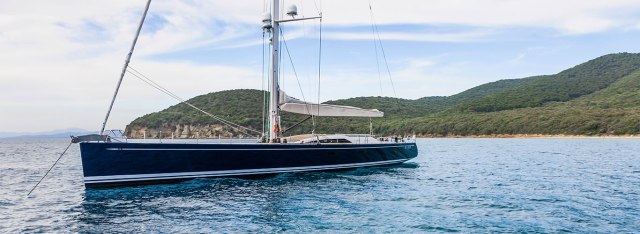
When I hear CSN’s Southern Cross I always tear up. The Blue of the title of this book is a 50 ft. offshore sailing yacht. Had I the chance to join her crew when I was young, I’d have been off like a shot. Hell, I’d be already aboard even now if they’d have me. Even knowing how the voyage will end.

I’d rank this book with The Secret History & The LIkeness as a griping story of friendship, belonging, commitment – as well as deceit, deception & death. There is little you can experience to match crewing a sailing yacht offshore for sheer intensity & a sense of belonging. Aboard The Blue we have the skipper, Aaron, a thirty-some New Zealander & a pick-up crew of early twenty-somethings: Denny, another Kiwi, Heinrich a German ex-tennis pro, Joseph a French former diving champion, Shell a Canadian jewellery maker, & two English girls who are BFs, Kitty, an aspiring actress, & Lana, an artist. From Lana’s POV we get the story in two time frames, what happened aboard the yacht during a passage from the Philippines to Palau & Lana’s thoughts eight months later when she’s living in New Zealand & The Blue is posted missing.

Aaron has a ‘no-relationships’ rule aboard the board. That makes sense because everyone aboard already has a very high maintenance relationship with the yacht herself & in such a confined space there’s no room for hanky-panky & the rivalries & hurt feelings that would ensue. Not, as we might expect, that the rule won’t be flouted & with the girls being two BFs & a Lesbian, the mixture is pretty volatile. Then Joseph, who was supposed to have left the crew in the Philippines, is discovered as a stowaway when they two days @ sea. During a night watch Joseph mysteriously disappears. As Lana was passed out from too much partying at the time, she doesn’t know what happened to him. Did he go over the side by accident, or was it suicide, or foul play? And what should Lana, & the rest of the crew, do?

Lana’s initial response is that they should ‘inform “the Authorities”’ about Joseph when they reach Palau, & I am sure that many readers will think the same. But that is not what the skipper & the majority of the crew, including Kitty, decide. I put the expression ‘the Authorities’ in scare commas because it is so ambiguous – I wondered that none of characters, especially Aaron who is supposed to have been a barrister, ask Lana the question, ‘What ‘Authorities”?” There is no official record that Joseph was aboard The Blue. He vanished on the high seas whilst on passage to the tiny Republic of Palau. (I’d barely heard of it before.) Joseph was a citizen of France. The Blue was registered in New Zealand & her skipper a Kiwi. So presumably the ultimate ‘Authority’ determining the disposal of Joseph’s case would be a coroner’s court in Auckland whose only evidence would have been whatever the crew of the The Blue told them. The Blue would have impounded & probably lost to pay legal fees however the case turned out.

This is the kind of moral dilemma that fascinates me. I think if I’d been in Lana’s situation when I was young I would have gone along with the skipper & crew, & I am absolutely certain I would now. It’s a question of loyalty & belonging, to the yacht & to the rest of the crew. But then had I been one of the Whitethorn House residents in Tana French’s The Likeness I’d have kept quiet about what happened to Lexie, who unlike Joseph I actually loved. And Whitethorn was just an old house. The Blue is a boat! Thank Heavens I’ve never had to decide something like that in real life. (Of course in The Secret History I would’ve helped dispose of Bunny too.)

I’d rank The Blue almost with The Likeness & The Secret History as contemporary tragedies. The setting, aboard a yacht on the high seas, is worthy of Conrad. But tho’ The Blue is clearly a five star (it disturbed my dreams last night – really) the characters, especially Lana, don’t quite achieve the level high tragedy requires. Given what we learn of his backstory, Aaron has the ingredients for truly tragic status, but we learn too little too late. (No, he does not resemble another classic sea-captain whose name begins with the same letter. But I would have had him as like Captain Lingard in Conrad’s The Rescue.) Lana seems to be another of those characters we keep encountering who are faced with a moral dilemma she hasn’t the education & ethos to know how to handle, who cannot distinguish between what’s legal & what’s right. Now that you’ve seen what a reviewer who thinks he does have those qualities would do, you might prefer to sail with a legalist like Lana. But for me in this particular case, what happens on the high seas should stay on the boat.

But fortunately for the reader & for Lana, the mystery doesn’t go down with the boat. The ending perfectly satisfied me, and as a tragic romance this is a wonderful story, & one I expect I shall continue to reflect on & to relate to the person I want to be. Every reader who enjoys sea-stories & stories about relationships & moral & spiritual issues should love it. It was also a wonderful audio travelling companion. Scarlett Mack was a superb narrator. She do the characters in different voices, Kiwi, English, North American perfectly to my ear. Her narrative voice I couldn’t quite place but I loved it. She pronounced ‘lower’ to sound almost like ‘lure’ to an American & her pronunciation of ‘palm’ like ‘Pam’ is the old nautical way – that’s how you say the name of the sailmakers tool.

The Starboard Sea by Amber Dermont

470 DingyII

What I wanted from this book was clear: a school story like Megan Abbott’s Dare Me, with junior sailing instead of competitive cheerleading, but the same intense concentration on fierce competition, bitter rivalry, high-octane jealous relationships, no-holds-barred tragic readiness to throw fate to the winds, young love, betrayal & death. In other words, a typical school term, but tweaked just a bit tighter. Tho’ I found it a great disappointment, The Starboard Sea had all of these proper ingredients. Unfortunately Amber Dermont failed to combine them well & some of them had gone more than a bit off.

The School

If you went to a decent school, you’ll remember the list we kept of where ex-classmates too thick, too crazy, or too criminal to be invited to rejoin us @ the end of term would probably go next. Bellingham could go to the top. A character in Evelyn Waugh’s Decline & Fall remarks, “We class schools, you see, into four grades: Leading School, First-rate School, Good School, & School. Frankly, School is pretty bad.” Bellingham is definitely “pretty bad.” Apparently the ISEE test score required for admission is a parent’s signature on a tuition check that’ll be honored by the bank, so it says a lot about how badly Jason managed to screw up @ his previous establishment that his father has to build Bellingham a new dormitory to get them to take him. The trouble with a really bad school (whether an inner-city public school with drug dealers in the corridors & bullies beating the shit out of you for your lunch money or a posh prep school with drug dealers in the dormitories & bullies beating the shit out of you for the sheer fun of it) is that they are comic in satiric fiction, tho in realistic fiction they’re tragic, which sometimes leaves the reader @ a loss whether to respond with laughter or tears. (I had that problem too with Anthony Breznican’s Brutal Youth.) Some of the satiric touches here went quite OTT for me. Bellingham is co-ed, unlike Jason’s previous school, & @ arriving on campus with his father, the dean tells Jason: “enjoy yourself. Our girls are grade-A fresh.” I can imagine a schoolmaster thinking like that – though he ought to be barred for life from working in education – but hardly actually saying it. (In fact, I cannot imagine the madam @ the better class of whorehouse saying it either!) Bellingham has a chapel but no carillon. “We marched into the building, bells echoing from a loudspeaker attached to a telephone pole.” If that didn’t make it obvious enough that this school’s a spiritual toxic waste dump, we discover that the icons “weren’t religious scenes or saints but generals and monarchs.” These include some rather anomalous characters: “Alexander the great, Julius Caesar, Marcus Aurelius, Attila the Hun.” Marcus Aurelius next to Attila the Hun? You’ve got to be kidding! Just how heavy-handed does the symbolism have to get? Spirituality is clearly not one of the cornerstone values @ Bellingham. The school is rife with bullies, with serious & criminal mayhem with a tragic outcome that the headmaster helps cover up – successfully. The good characters, Aiden, Chester, & even Jason, deserved a chance @ a better formation.

The Sailing

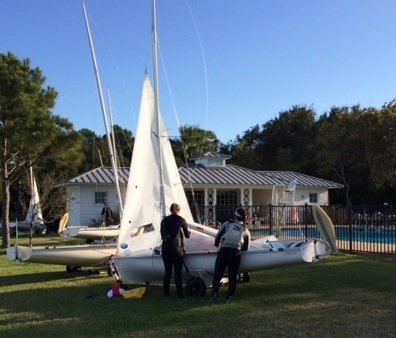
In the world of yacht racing, dinghy sailors are the sprinters – ocean racers the cross-country runners. If dinghy sailing is new to you, go to fireballsailing.org.uk & watch their video. Those boats are Fireball dinghies, which are what Bellingham School sails. The person sitting aft @ the helm is the skipper & the crew is forward, hanging on a wire off the boat with only feet touching the rail out on a contraption called a “trapeze”; that’s the “wireman.” In the photo above, which shows the skipper & crew of 470 (similar to a Fireball) unbending the sails after bringing the boat ashore, the figure in black wetsuit is the wireman & the girl wearing the white lifevest is the skipper.  The skipper steers the boat & makes the tactical decisions, when to head for the start line & when to go about & jibe, as well as handling the mainsheet. The crew controls the jib & spinnaker sheets, sets & retrieves the spinnaker, & whenever the boat comes about has to swing into the cockpit, unhook from the wire, hook up & swing out on the new windward side, while trimming the jib on the new tack. It requires tremendous athleticism. Just as being an equestrienne uses the skills of a cavalry officer in Wellington’s day, I’d reckon a good wireman would have made an excellent foretop-man on a square rigger. I’m rather elaborating a lot about dinghy sailing for a book review, but to get a take on The Starboard Sea you have to know more about dinghy sailing than Amber Dermont bothers to tell you. (In contrast with Dare Me, where Megan Abbott gives the reader a real taste of competitive cheer, or the equestrian detail of Anton DiSclafani’s Yonahlossee Riding Camp for Girls.) The critical championship race for the Tender Trophy is summarized in a couple of perfunctory sentences; we hear nothing about the strategy, tactics, or what the other boats are doing, either the competition or the teammates, tho’ interscholastic sailing is usually a team sport. Instead of learning about dinghy racing, we get a lot of nautical padding. Jason loves to expiate on celestial navigation, whaling history (which he gets wrong, imagining that the harpooner was supposed to kill the whale on the first strike & that going aloft you’d “claw the ratlines” – you’d better grasp the shrouds instead), correcting compass deviation & circumnavigating the globe, none of which has any relevance to dinghy racing. I’ve never encountered any real sailor who thinks or talks at all like him. The atmosphere of this book is like one of those seafood restaurants with Captain’s chairs @ the tables & fake anchors, running lights, lobster buoys & knot boards on the walls.

The high-octane jealous relationships, no-holds-barred tragic readiness to throw fate to the winds, young love, betrayal & death, &c: that is to say, The Good Stuff

Like Addy in Dare Me, the Starboard Sea features a 1st person narrator, Jason Prosper. It’s not clear how symbolic his name: Jason is an excellent name for a good sailor if you’ve read the Argonautica & equally appropriate for a prime sleazeball if you’ve read the Medea. I doubt his parents ever heard of either & altho’ dad is supposed to be old money and a Princeton alumnus, he drives a Cadillac & keeps a mistress @ the St. Regis. Jason is carrying a lot of baggage. After his BF & roommate Cal committed suicide, Jason managed to get himself expelled from his previous school. Only @ the very end of the book do we find out why Cal hanged himself (would he really have used “eight stranded nylon rope”? nylon stretches), tho’ we get lots of hints throughout that Jason feels responsible. (view spoiler) With a 1st person narrator there’s often a problem with disclosure, but here I felt it would have been a much better book is we had known from the start what albatross Jason is carrying round his neck. (Couldn’t resist an allusion.) That would have accounted for his passivity & diffidence in entering into relationships, something that I found puzzling throughout this book – Jason’s like a Raymond Carver or Ann Beattie character tho’ his ultimate progenitor’s probably J. D. Salinger. The only attractive character is Aidan – a girl despite being named for a male Anglo-Saxon saint – who is indeed a kind of castaway, & who @ the end proves to be much braver & loving than Jason could ever deserve. Had I been writing this book, I would have made her a junior sailor herself & Jason her wireman & I also would not have kept the story going on for so long after writing her out of it, as she is the only interesting & energetic character in the book. (I loved her backstory about her lesbian affair @ her previous school with Hannah her art teacher – teacher’s husband forced Hannah to end the relationship & Aidan got expelled for smashing all Hannah’s stained glass.). Unfortunately, Amber Dermont has knocked herself out to make Aidan not only a character but a “character” – she thinks Robert Mitchum is her real father (personally I’ve never found him attractive) & has a collection of Fred Astaire’s dancing shoes. But I did love her & from the very 1st moment Jason spots her standing out on the water, we sense there’s dark cloud round her brows – this girl’s beautiful & she’s doomed.

My Take

I really wanted to like this book but reading it was a long & tedious slog. Some of the faults are obvious & could have been corrected with better editing: the bad school is too much a caricature, perhaps intended for readers eaten alive by class envy (like the author of the blurb), the dinghy sailing should have been intense, vividly & accurately depicted (just what was that ”bundle of knotted rope” – a phrase no sailor would ever use – “hanging off the boom” of the Fireball that entangled Race’s neck?) Jason’s forced nautical allusions (gazing into Aidan’s eyes he says, “I capsized into them” – that I am still trying to imagine) should have been excised along with the whaling museum. I’d not have allowed Aiden to disappear from the book so soon. But I fear the principal problem is that the author was trying too hard to write “literary fiction” so instead of a brave & energetic central character such as we have with Beth Cassidy or Thea Atwell, we get in Jason a passive ditherer mixing Ishmael with Holden Caulfield. Amber Dermont did well to create Aiden; she ought to have made her the hero.

The Ice Twins by S. K. Tremayne

Not only were Kirstie & Lydia absolutely physically indistinguishable six-year-old Identical twins, but one of them is dead – killed in a fall from a window – & their parents Sarah & Angus don’t know which one’s the survivor. They were sure that it was Kirstie, but now the child insists she is really Lydia, an Identification seconded by the family dog. To make things even more difficult for the anxious parents, financial circumstances have forced them to sell-up & move from London to a remote abandoned lighthouse-keeper’s cottage on an Island off the coast of Scotland. (Not long ago I heard an ad on local radio offering ‘lighthouse keeping’ – something I’d not realised we’d much need for here in Iowa. What a disappointment to find it was an ad for a home-health-care service & that the speaker apparently was trying to pronounce ‘light housekeeping’!) Other children @ the local Gaelic-English bilingual school perceive there is something distinctly wrong with the little girl & think she is some kind of a ghost. Sarah is frantic to discover who her daughter actually is & what really happened to her sister?

The Ice Twins is a brilliant novel of suspense; I think the best I’ve read so far this year. What made this story particularly fascinating was forming so many hypotheses that fit the facts plausibly, including: (1) After her sister was killed in an accidental fall, extreme grief led her twin to adopt her identity & mannerisms. (2) One twin killed the other by pushing her out the window, acting out of jealousy. (Angus favoured Kirstie, Sarah Lydia.) (3) Kirstie was a victim of sexual abuse by Angus, who was fond of caressing her. (4) The ghost of the dead twin is haunting her surviving sister & traces of her ghostly presence can be sensed by Sarah & by other children. (5) Sarah is an extremely unreliable 1st-person narrator, having been on meds, been unfaithful to Angus, & is possibly delusional. We should distrust anything she says. (6) Angus is drinking heavily & is given to fits of uncontrollable anger & may be dangerous.

These are not mutually exclusive: there could be possession by the ghost of a dead child who was sexually abused, & murdered by . . . etc. All could be true. Or some other explanation entirely. That is one of the things that kept me drawn to this book, its sheer ambiguity. Is it a family drama? A crime story about an abused &/or murdered child? A story about a spouse suffering a breakdown? A gothic set in a haunted house in an eerie romantic setting? A tale of supernatural possession? All of the above?

Usually an author’s trying to work too many genres simultaneously leads to artistic failure because each has its own rules. Many readers of ‘realistic fiction’ cannot abide the presence of the paranormal whereas ghosts are part of the furniture in supernatural fiction. Do we have to explain them away as products of the narrator’s disturbed psyche to take a book seriously? Definitely not in my case but if you do, you should still enjoy this book – Sarah’s psyche is indeed pretty disturbed – & be unable to put it down if only to find out how it is going to turn out. The style & the dialogue are excellent as well. I especially loved the Glasgow child psychologist. Tremayne treads the lines between the various genres so delicately as not to put a foot wrong. there is just the right mix of spooky stuff, of family dynamics, & of the effects of grief @ a high level of acuity. Also a great supporting cast of Scottish boatmen to pull you literally out of the muck & excellent taste in whisky.

When you have read a really good book in a particular genre, your perceptions become sharper, & you enjoy other good books like it even more than before. So if you enjoy The Ice Twins, you might like Niki Valentine’s novels The Haunted & Possessed – both deal with some similar situations & subjects, the latter featuring adult twins.